top of page
3:16 Roofing and Construction, roofing blog, how to, DIY, repairs, maintenance, blog, roof blogs

Check out our Blogs Topics by
3:16 Roofing and Construction

Blog How-to's, DIY's, Installations, Repairs, Maintenance, Best Practices and more.

All Posts

Updated: Apr 30


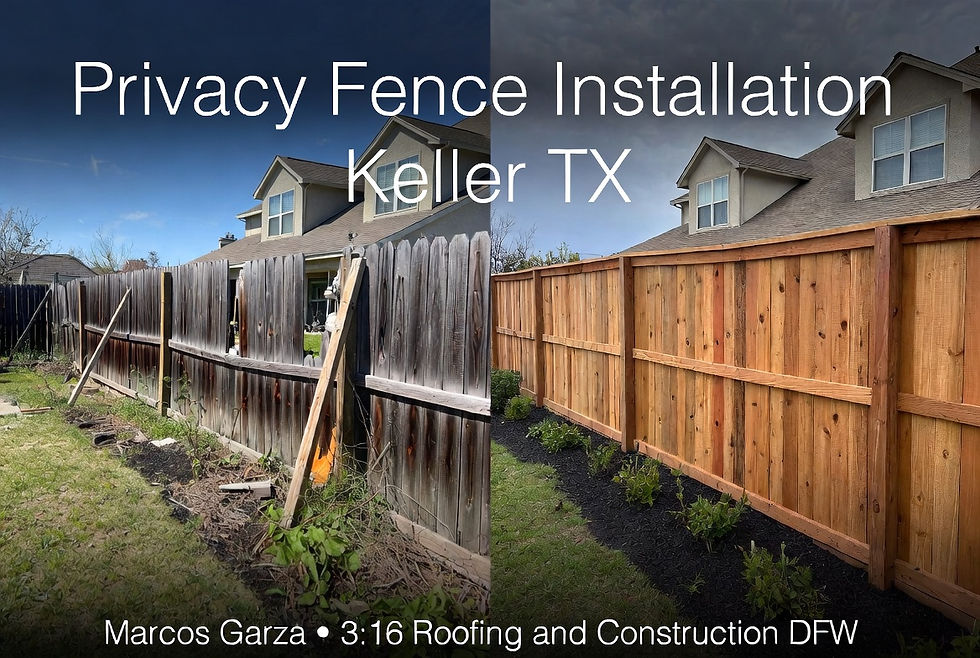
Privacy Fence Installation Keller TX

When you need a quality privacy fence for your home in Keller, Texas, you want a contractor who understands local soil conditions, neighborhood HOA rules, and the demands of our Texas climate. At 3:16 Roofing and Construction, we've been installing beautiful, durable privacy fences throughout Keller and the surrounding DFW area since 2017. Our dedicated fencing division, 3:16 Fences, specializes in creating the perfect outdoor privacy solution for your property.

Whether you're looking to shield your backyard from a busy street, create a secure space for your family, or simply add curb appeal to your home, our fence installation team has the expertise and local knowledge to get the job done right. With a 4.9-star rating across 235 Google reviews and BBB A+ certification, you can trust our team to deliver results. Call (817) 402-7663 for a free estimate.

Why Keller Homeowners Choose 3:16 Fences

The DFW area, including Keller, sits on expansive clay soil that shifts with seasonal moisture changes. This soil movement causes fence posts to heave, pushing them upward and out of the ground. If your fence installer doesn't account for this, you'll face sagging panels and leaning posts within a few years. Our team installs posts deep enough and uses proper footings to prevent heave damage.

Another consideration specific to Keller is the Texas heat and intense sun exposure. Cedar fences require re-staining every two to three years to maintain their appearance and protect against UV damage. Many neighborhoods in Keller have HOA restrictions on fence height, material, and style. Popular communities like Marshall Ridge, Bear Creek, Hidden Lakes, and Shady Oaks all have specific guidelines. Keller's typical fence height limit is four feet in front yards and six feet in backyard areas.

Privacy Fence Materials We Install

Cedar is the classic choice for privacy fences throughout Texas. It looks warm and natural, ages gracefully, and resists decay and insects naturally. Properly maintained cedar fences typically last 15 to 20 years. Pine is a budget-friendly alternative that's lighter in color and less expensive to install. Composite fencing combines wood fibers with plastic resin for a maintenance-free option that lasts 20 to 30 years. Wrought iron with privacy slats offers elegance and security for upscale Keller neighborhoods.

Privacy Fence Installation Cost in Keller, TX

Privacy fence pricing in Keller typically ranges from $25 to $45 per linear foot, depending on material choice, fence height, and site conditions. A cedar fence usually costs between $30 and $45 per linear foot. A 150-linear-foot cedar fence six feet tall would run approximately $4,500 to $6,750 installed. Pine fencing starts around $25 to $35 per linear foot. Composite fences run $40 to $50 per linear foot but save money long-term since you won't invest in repeat staining.

Your final cost also depends on factors like mature trees, soft soil requiring deeper footings (common in Keller due to clay), or difficult access for equipment. We provide a free estimate that accounts for your specific site conditions and material preferences.

Keller Neighborhoods We Serve

Keller is a growing community with a mix of established neighborhoods and new construction. Lot sizes range from modest quarter-acre properties to expansive half-acre and larger homesites. Whether you're in the newer construction areas or established neighborhoods like Marshall Ridge, Bear Creek, Hidden Lakes, or Shady Oaks, privacy fencing is a smart investment that adds real value to your home.

Our Installation Process

We start with a free on-site estimate where we assess your property, review HOA guidelines, discuss material options, and provide a transparent price. We handle all permitting and inspection coordination. On installation day, our crew marks the fence line, sets posts at the proper depth to prevent heave, and installs panels securely. Most residential privacy fence projects in Keller are completed within a week or two.

Why Choose 3:16 Roofing and Construction

Owner Marcos Garza founded 3:16 Roofing and Construction in 2017 with a commitment to honest pricing and exceptional craftsmanship. We've earned a 4.9-star Google rating with 235 reviews. We're BBB A+ rated and Google Guaranteed. When you call us at (817) 402-7663, you're talking to a team that genuinely cares about your satisfaction.

Frequently Asked Questions

What is the best privacy fence material for Keller, Texas? It depends on your priorities. Cedar offers natural beauty but requires re-staining every two to three years. Composite is maintenance-free but costs more upfront. Pine is budget-friendly but needs regular maintenance. Wrought iron with privacy slats adds elegance and lasts 30+ years.

How deep should fence posts be in Keller soil? Keller's expansive clay soil requires posts at least 24 to 30 inches deep, with concrete footings that extend below the active soil zone where seasonal moisture changes occur.

Can my fence height be six feet? Most Keller HOAs allow four-foot fences in front yards and six-foot fences in backyard areas. We review your specific HOA guidelines before any work begins.

How often should I stain or seal my wood privacy fence? Cedar and pine fences in the Texas climate should be re-stained or sealed every two to three years due to intense sun and storms.

What does your privacy fence installation include? Site assessment, free estimate, HOA and code compliance verification, professional installation with quality materials, post setting to prevent heave, and final cleanup. Call (817) 402-7663 to get started.


If you live in the Dallas-Fort Worth area, you've probably experienced the gut-wrenching sound of hail pounding your roof. We at 3:16 Roofing and Construction understand that feeling all too well. Every spring and summer, our phone rings constantly with homeowners who've just weathered another severe storm. The question we hear most often is: Are Class 4 impact-resistant shingles really worth the money?

The short answer? In Texas, they absolutely can be, especially when you factor in insurance discounts. Let's break down what Class 4 shingles actually are, how much you'll spend, and whether that investment makes financial sense for your home.

What Are Class 4 Shingles and the UL 2218 Test?

Class 4 shingles are the highest impact-resistance rating available for residential roofing. They're tested under the UL 2218 standard, which is the gold standard for impact resistance in the roofing industry.

Here's how the test works: manufacturers shoot steel balls at shingles from a height of 20 feet. The balls are 2 and 1.25 inches in diameter, and they're dropped repeatedly on the same spot. Class 4 shingles must show no tears, cracks, or permanent indentation after all impacts. It's a brutal test, and shingles that pass it prove they can handle serious hail.

For comparison, Class 3 shingles pass a similar test but with slightly smaller balls. Standard shingles? They don't meet any impact resistance standard at all. In Texas, where hail storms are a fact of life, that difference is significant.

When we install Class 4 shingles at your home, you're getting a product that's undergone rigorous, third-party verification. That matters. It means your insurance company will recognize it. It means when a hailstorm hits your neighborhood, you'll likely be filing fewer claims.

Cost Comparison: What's the Real Price Difference?

Let's talk numbers, because Class 4 shingles do cost more upfront. Class 4 Impact-Resistant Shingles cost $5.25 to $6.75 per square foot (installed), while Standard Shingles cost $4.75 to $5.75 per square foot (installed).

For an average 2,000-square-foot roof in the DFW area, you're looking at a difference of roughly $1,000 to $4,000 depending on the brand and complexity of your roof. Now, that sounds expensive. But here's where Texas economics come into play. Most homeowners see that extra cost back through insurance discounts within 3 to 5 years. Some see it back even faster.

The real math happens at your insurance company's office, not at our estimate meeting.

Texas Insurance Discount Math: How Much Do You Actually Save?

This is the part that makes Class 4 shingles a smart investment for most Texas homeowners. When you install Class 4 shingles, your homeowners insurance company will typically offer a discount on your dwelling coverage. We're talking about a 20 to 35 percent reduction on your dwelling premium, according to the Texas Department of Insurance. Some policies see even bigger discounts.

Let's put that in real terms. If your annual homeowners insurance is $1,200 and your dwelling premium is $900, a 25 percent discount means you save $225 every single year. Over the life of your shingles (more on that in a moment), that adds up to thousands of dollars.

But that's not all. Class 4 shingles can also lower your deductible on hail claims. Some insurers offer $0 deductible options for Class 4 roofs, which means when hail does damage your roof, you don't pay anything out of pocket before the insurance kicks in. That's huge in Texas. Call us at (817) 402-7663 if you want to verify what your specific insurance company will offer. We work with homeowners on this all the time and can help you understand your options.

Understanding TDI Form PC068

The Texas Department of Insurance requires insurance companies to disclose their discounts clearly. That's where TDI Form PC068 comes in. This form lists all the discounts available for your specific homeowners insurance policy. It's your roadmap to understanding exactly what you qualify for and what you save. Many homeowners don't even know this form exists, but it should be part of every conversation about Class 4 shingles in Texas.

When you call us to schedule a free roof inspection at (817) 402-7663, ask your insurance agent to pull up your TDI Form PC068. Look for these discount categories: Impact-resistant roofing materials, Hail-resistant roofing systems, Updated roofing system, and Roof system reduction (age-based). Some policies stack multiple discounts. For example, you might get both an impact-resistance discount AND a new roof discount if you're replacing an older roof.

The TDI website also maintains a database of average discounts by company, so you can see if yours is above or below market rates. It's worth checking.

Best Class 4 Shingle Brands for Texas

We install and recommend three major brands of Class 4 shingles. All three perform exceptionally well in our Texas climate, and all three are backed by strong warranties.

CertainTeed SELECT ShingleMaster: CertainTeed makes some of the most durable Class 4 shingles on the market. Their SELECT ShingleMaster line is engineered specifically for impact resistance while maintaining excellent wind rating and color retention. CertainTeed roofs regularly last 25 to 30 years in Texas heat, and their warranty backs that up. The shingles have a distinctive appearance, and many homeowners love the architectural look they bring to their homes.

Malarkey Emerald Pro: Malarkey is an environmental leader in roofing, and their Emerald Pro line doesn't sacrifice performance for sustainability. These shingles are made with recycled plastics and rubber, which sounds different until you realize it actually makes them tougher in hot climates. We've installed hundreds of Malarkey roofs across Tarrant County, and they hold up beautifully to our summer heat and spring hail.

IKO Roof Pro SELECT: IKO's Roof Pro SELECT line is a workhouse. It's one of the most popular Class 4 options in the DFW area because it balances price and performance well. These shingles resist impact damage, maintain their color in our brutal Texas sun, and come with a strong 30-year warranty. We've seen IKO Class 4 roofs go toe-to-toe with hailstorms that destroyed neighboring roofs of lesser quality.

All three of these manufacturers offer genuine 25 to 30-year warranties on Class 4 products when installed properly. That's your protection.

How Long Do Class 4 Shingles Actually Last?

Here's a reality check: Class 4 shingles don't last forever, but they do last longer than standard shingles in Texas conditions. In our climate, a standard asphalt shingle roof typically reaches the end of its useful life at 15 to 20 years. The combination of intense summer heat, UV radiation, and repeated temperature cycles breaks down the asphalt and granules. Add in occasional hail damage, and many standard roofs need replacement even sooner.

Class 4 shingles, installed properly, should last 25 to 30 years in Texas. The impact-resistant composition is more resilient to degradation. The granules stay in place longer. The asphalt doesn't dry out and crack as quickly. But that longer lifespan only happens if installation is done right. That's why choosing a qualified contractor matters. At 3:16 Roofing and Construction, we're CertainTeed SELECT ShingleMaster certified, Malarkey Emerald Pro certified, and IKO Roof Pro SELECT certified. Our certifications mean we've passed manufacturer training and must follow their installation standards. Your warranty depends on proper installation.

The Texas heat works against all roofs, though. If you live in a neighborhood like Marshall Ridge in Keller or Timarron in Southlake, where homes face southwest and get afternoon sun exposure, your roof will age faster than a north-facing roof. Class 4 shingles help mitigate that effect, but they don't eliminate it. It's just physics.

DFW Hail Statistics: Why This Matters

The National Weather Service tracks hail events carefully across North Texas. Their data shows the DFW area experiences 3 to 5 significant hail events per year on average. Some years we see more. Some years less. But the trend is clear: hail is not an exception in Texas. It's a predictable occurrence.

Tarrant County sits directly in what we call the I-35W hail corridor. Severe thunderstorms moving from Oklahoma and western Texas frequently track along this corridor, and Tarrant County is right in the path. Our specific geography makes us particularly vulnerable.

The spring storm season (April through June) is especially active. That's when we see the biggest, most destructive hail events. If your roof is near the end of its life when spring rolls around, you're taking a real gamble with standard shingles. This is also why April (like right now) is the perfect time to schedule a free inspection. After winter and before the spring storm season really kicks into gear, we can assess your roof and help you make an informed decision. Call us at (817) 402-7663 to set up your appointment.

Why 100-Degree Summers Matter

People often think of hail when they think of roof damage, but heat is an underrated threat to shingles. Texas summers regularly push 100 degrees Fahrenheit, and roofs sit even hotter. Black or dark-colored shingles on a sunny day can reach 160 degrees. That kind of heat breaks down the asphalt binder in standard shingles faster than cooler climates. It accelerates aging. It causes curling and cracking years before a standard 20-year-old roof in Minnesota would show similar wear.

Class 4 shingles are manufactured with better asphalt compounds and backing materials specifically designed to handle extreme heat. They don't eliminate the effects of Texas summer, but they significantly reduce heat-related degradation. It's one more reason the longer lifespan of Class 4 products makes sense for our region.

Frequently Asked Questions About Class 4 Shingles

Q: Will my insurance company give me a discount before I install Class 4 shingles? A: No. Insurance discounts apply after installation is complete and verified. Some companies require photo documentation or a home inspection. We can coordinate with your insurance company to make this process smooth.

Q: Can I install Class 4 shingles over my existing roof? A: In most cases, yes. Texas building codes allow up to two layers of shingles in Tarrant County. However, we usually recommend tearing off the old roof. Proper installation on a clean deck ensures maximum life and warranty coverage. Plus, it gives us a chance to inspect your decking and framing for hidden damage.

Q: Do Class 4 shingles look different from standard shingles? A: Slightly. Different brands have different appearances, and Class 4 products often have a slightly thicker profile. The look is still attractive and appropriate for residential homes. Most of our customers love how they look.

Q: What if hail damages my Class 4 roof? A: Impact-resistant doesn't mean impact-proof. A very severe hailstorm can still damage Class 4 shingles, though it's significantly less likely than damage to standard shingles. If damage does occur, your insurance claim will be processed quickly because the roof meets Class 4 standards. Repair costs are also usually lower because the damaged area is well-defined rather than spread across the entire roof.

Q: How do I know my Class 4 shingles were installed correctly? A: That's where manufacturer certification matters. At 3:16 Roofing and Construction, we're BBB A+ rated, Google Guaranteed, and hold certifications from CertainTeed, Malarkey, and IKO. We follow their installation specifications exactly. Your warranty is only valid if installation meets manufacturer standards. Ask any contractor whether they hold manufacturer certifications before hiring them.

Final Thoughts

Class 4 impact-resistant shingles in Texas make sense for most homeowners. The upfront cost is higher, but insurance discounts typically recover that investment in 3 to 5 years. Beyond the financial equation, you gain peace of mind. When hail comes (and in Texas, it will), your home is protected.

We've installed thousands of roofs across the DFW area since 2017. We've seen the difference Class 4 shingles make in neighborhoods from Keller to Southlake to downtown Fort Worth. We know this market. We know our products. And we know what works in Texas conditions.

If you're considering Class 4 shingles, the next step is a free inspection. We'll examine your current roof, discuss your insurance situation, and explain exactly what Class 4 installation would mean for your home and your wallet.

Call 3:16 Roofing and Construction at (817) 402-7663 today to schedule your free inspection.


When a hailstorm or wind damage hits your home in the Dallas-Fort Worth area, filing a roof insurance claim can feel overwhelming. We understand the stress of dealing with damage, navigating insurance companies, and wondering if you'll get fair compensation. That's why we've created this complete guide to walk you through the entire process.

At 3:16 Roofing and Construction, we've helped hundreds of DFW homeowners successfully navigate their insurance claims. Our team knows Texas insurance rules inside and out, and we're here to help you understand every step.

When to File a Claim

The timing of your claim matters more than you might think. Here's what you need to know: File within the required timeframe. Texas law doesn't specify a single deadline, but most insurance policies require you to file within one to three years of the damage. Don't wait too long, as delay can hurt your case. Spring storm season is prime time. In DFW, Tarrant County experiences frequent hail during spring and early summer, typically from April through June. Severe weather season means our phones ring constantly with homeowners facing damage. Document everything immediately. Take photos and videos of all damage right after the event, before weather or time can change the appearance of your roof. This evidence becomes crucial during the claims process. Call your insurance company quickly. Once you've documented damage, contact your insurer without unnecessary delay. The Texas Department of Insurance recommends reporting within a reasonable timeframe to avoid complications.

Step-by-Step Claim Process: 5 Steps to Success

Step 1: Document the Damage Thoroughly

Before you contact anyone, gather evidence. Walk around your property (safely) and photograph or video every area showing damage. Capture roof condition from the ground and, if safe, from a ladder or elevated view, damaged gutters, fascia, or soffits, hail damage on vents, flashing, or visible shingles, interior damage like water stains, leaks, or damaged ceilings, and any debris from the storm. Create a dated record of all photos and videos. Many homeowners miss important details because they don't capture them immediately.

Step 2: Review Your Insurance Policy

Pull out your homeowner's insurance policy and read the key sections: your coverage limits for roof damage, your deductible amount, any exclusions that might apply, time limits for filing, and requirements for obtaining estimates. Understanding these details prevents surprises later. If anything is unclear, call your insurance agent for clarification.

Step 3: File Your Claim

Contact your insurance company through their standard channels. You can usually file online, by phone, or through your agent. Provide your policy number, the date of the damage, a clear description of what happened, your documentation (photos and videos), and any preliminary estimates if you have them. The insurer will assign a claims adjuster to your case. This adjuster inspects the damage and determines coverage and payment amounts.

Step 4: Schedule the Insurance Adjuster Inspection

Your insurance company will contact you to schedule an inspection. The adjuster is responsible for assessing the damage and writing up the claim report. During this inspection be present when the adjuster arrives, point out all damage you've noticed, ask questions about their findings, request a copy of their report, and take your own photos during the inspection for comparison. Having a licensed roofing contractor like our team present during this inspection can protect your interests. We can identify damage the adjuster might miss and ensure your claim reflects the full extent of repairs needed.

Step 5: Receive Payment and Proceed with Repairs

Once approved, you'll receive a check. In Texas, you typically receive an initial payment, and then a final payment after repairs are completed and verified. The payment amount depends on your coverage and deductible. If the damage exceeds your initial estimate, you can file for additional compensation through a supplemental claim, which we'll discuss later.

What Insurance Covers vs. What It Doesn't

Insurance typically covers: storm damage from hail, wind, or heavy rain, lightning strikes, sudden and accidental damage, falling tree damage (usually), and structural damage to the home. Insurance typically does NOT cover: normal wear and tear, damage from lack of maintenance, gradual leaks over time, damage from your own negligence, damage from poor installation, and issues caused by existing roof defects. The Texas Department of Insurance provides guidelines for what carriers must cover, but policies vary. Always ask your adjuster specifically what is and isn't covered in your claim.

Common Mistakes Homeowners Make

We've seen these errors cost people thousands in lost claims: Delaying the claim costs you because the longer you wait, the harder it is to prove the damage was recent and storm-related. Not getting multiple estimates means we always recommend getting at least two contractor estimates. If estimates vary significantly, this helps justify higher claim amounts.

Accepting the first adjuster report without question is risky because adjusters work for the insurance company, not for you. Their initial assessment may be conservative. You have the right to dispute their findings. Skipping a licensed contractor inspection costs you because our team can spot damage you might miss and provide documentation that supports your claim.

Making repairs before settling is a mistake because you should never start repairs until your claim is finalized and you have a clear settlement amount. Early repairs can actually reduce your claim value. Not filing supplemental claims means if your repairs end up costing more than the initial estimate, you can and should file for additional compensation.

ACV vs. RCV Explained

This is one of the most important concepts in roof insurance claims: ACV (Actual Cash Value) means your insurer pays based on your roof's age and condition. A 15-year-old roof is worth less than a brand-new roof, even though replacing it costs the same amount. Most basic policies use ACV.

RCV (Replacement Cost Value) means your insurer pays for the full cost of replacement, regardless of your roof's age. This is a better option for homeowners but typically costs more in premiums. If you have an older roof, RCV coverage is worth considering. We recommend reviewing your policy with your agent to understand which type you have.

How Deductibles Work in Texas

Your deductible is the amount you pay out of pocket before insurance pays anything. In Texas, deductibles for hail and wind damage typically run 1-2% of your home's total dwelling coverage. Here's an example: If your home's dwelling limit is $300,000 and you have a 1% deductible, your deductible for hail damage is $3,000. If your roof damage costs $8,000, your insurance pays $5,000 and you pay $3,000.

Some policies have flat deductibles ($500 or $1,000), percentage-based deductibles (1-2% of dwelling value), or separate deductibles for hail vs. other perils. Understanding your deductible helps you know exactly what to expect from your claim payout.

Supplementing Low Estimates

Sometimes the initial insurance estimate doesn't cover the full cost of repairs. This happens because the adjuster missed some damage, repair costs increased since the estimate, or hidden damage becomes apparent during work. In these cases, you can file a supplemental claim.

Here's how: Get a detailed written estimate from your contractor showing all repairs needed, compare it to the original estimate and highlight discrepancies, provide photos of damage discovered during the repair process, and submit the supplemental claim to your insurer with supporting documentation. Many homeowners don't realize they can file supplementals, leaving money on the table. We help our clients maximize their claims through this process.

Frequently Asked Questions

Q: How long does the claims process take? A: Typically 2-6 weeks from filing to receiving your initial payment. Supplemental claims may take additional time. Delays can occur during busy storm season when adjusters are backlogged.

Q: Can I choose which contractor repairs my roof? A: Yes. Insurance companies cannot require you to use a specific contractor. You have the right to choose any licensed, qualified roofer. We're happy to discuss your options at (817) 402-7663.

Q: What if I disagree with the insurance adjuster's assessment? A: You can request an independent inspection, hire a public adjuster, or pursue appraisal through your policy. Many carriers are required to resolve disputes through appraisal if you disagree with their assessment.

Q: How much will my insurance increase after filing a claim? A: This varies by insurer and your claim history. Some carriers increase rates, while others don't for weather-related claims. Ask your agent about potential rate impacts before filing.

Q: Do I need a contractor present during the inspection? A: Not required, but it's smart. A licensed roofer like our team can identify damage you might miss and advocate for your interests. Call us at (817) 402-7663 to discuss whether a contractor inspection makes sense for your situation.

Ready to File Your Claim? We're Here to Help

The roof insurance claim process doesn't have to be confusing. At 3:16 Roofing and Construction, we've worked with hundreds of DFW homeowners through this journey. Whether you need help documenting damage, understanding your policy, getting an estimate, or disputing an adjuster's findings, our team is ready.

We're a fully licensed roofing contractor with over a decade of experience in the Dallas-Fort Worth area. Our team holds a RCAT license (#03-0246), maintains a BBB A+ rating, and is Google Guaranteed. With 4.9 stars from 235 customer reviews, we're trusted by homeowners throughout DFW.

Don't navigate this process alone. Call us today at (817) 402-7663 for a free inspection and estimate. We'll make sure your insurance claim reflects the true cost of your roof repairs.

 
bottom of page